Morocco
Marrakech
A walled red city of tangled lanes
At dusk, the square sets the table
Marrakech is a city whose old medina is wrapped in walls of red earth. At the heart of this former royal capital, founded in the 11th century, lanes too narrow for cars still knot together, and donkey carts, motorbikes and people hauling loads squeeze past one another. By day you lose your bearings in the souks; as the light drops, you follow the charcoal smoke rising over Jemaa el-Fna to find dinner. Then you shut the heavy wooden door of your riad behind you, and a courtyard waits where the only sound is the fountain.
The medina inside red walls
Marrakech is called the Red City because its walls and most of its houses are the color of red earth. Pass through a gate (bab) into the medina and the lanes narrow fast, and the blue dot on your map app starts pointing somewhere it shouldn't. That's when the minaret of the Koutoubia Mosque comes in. At 77 meters, it can be seen from anywhere in the medina, and Morocco's tourism office describes it as the lighthouse of Marrakech. As a rule, only Muslims may go inside the mosque, so you'll hear the call to prayer, five times a day, from the gardens outside. At riads deep in the lanes, staff often come out to the nearest square to meet guests and carry bags. Agree on a meeting point when you book, and you won't be dragging a suitcase around late at night looking for the door.
Jemaa el-Fna by day and by night
Jemaa el-Fna, the triangular square at the entrance to the medina, has been a symbol of Marrakech since the city was founded in the 11th century. The cultural space of this square, where storytellers, poets, snake charmers and Gnaoua dancers share the ground, is on UNESCO's Intangible Cultural Heritage list. By day, orange juice carts and henna artists fill the square. As the sun drops, rows of numbered food stalls go up in their place, and between the charcoal smoke and the calls of the stallholders, the whole square becomes one big open-air restaurant. If you've stopped to watch a performance for a while, it's customary to hand over a few coins. If someone offers to put a monkey or a snake on your shoulder, a wave of the hand is enough to decline. From an upper terrace at one of the cafés around the square, you can look out over the smoke to the Koutoubia minaret beyond.
Getting lost in the souks
The souks spreading north from the square are where you'll spend the most time in the medina. Each lane has its own trade, so you tell them apart by the tapping of brass lamps, the smell of tanned leather, or skeins of dyed yarn hung from poles. Most shops have no price tags, so prices are settled by bargaining. Ask at a few shops first, and if the owner offers tea, it's fine to take a glass and talk without hurrying. If someone you didn't ask tells you 'that way's closed' and starts leading, following tends to end at a tannery or a shop they know, with a request for a guiding fee. Politely decline and keep going. And if someone approaches offering a cheap desert tour, it's safest not to engage at all.
Gardens and a ruined palace
When you want a break from the noise, head to Jardin Majorelle in the new town. French painter Jacques Majorelle began planting it in 1922 with specimens from around the world, shaping it over 40 years into a 9,000-square-meter garden. In 1980, when hotel developers threatened it, Yves Saint Laurent and Pierre Bergé bought it and saved it. The garden opens at 8am and the Musée Yves Saint Laurent next door at 10am, so walk the garden early while it's quiet, then move on to the museum. In the south of the medina, the Palais El Badi sits close to the Saadian Tombs, so they're easy to see together. El Badi is a wide ruin, its roofs gone and only earthen walls left, with stork nests perched on the crumbling tops. It's a place where you end up sitting a long while in the afternoon sun.
Tanjia and mint tea
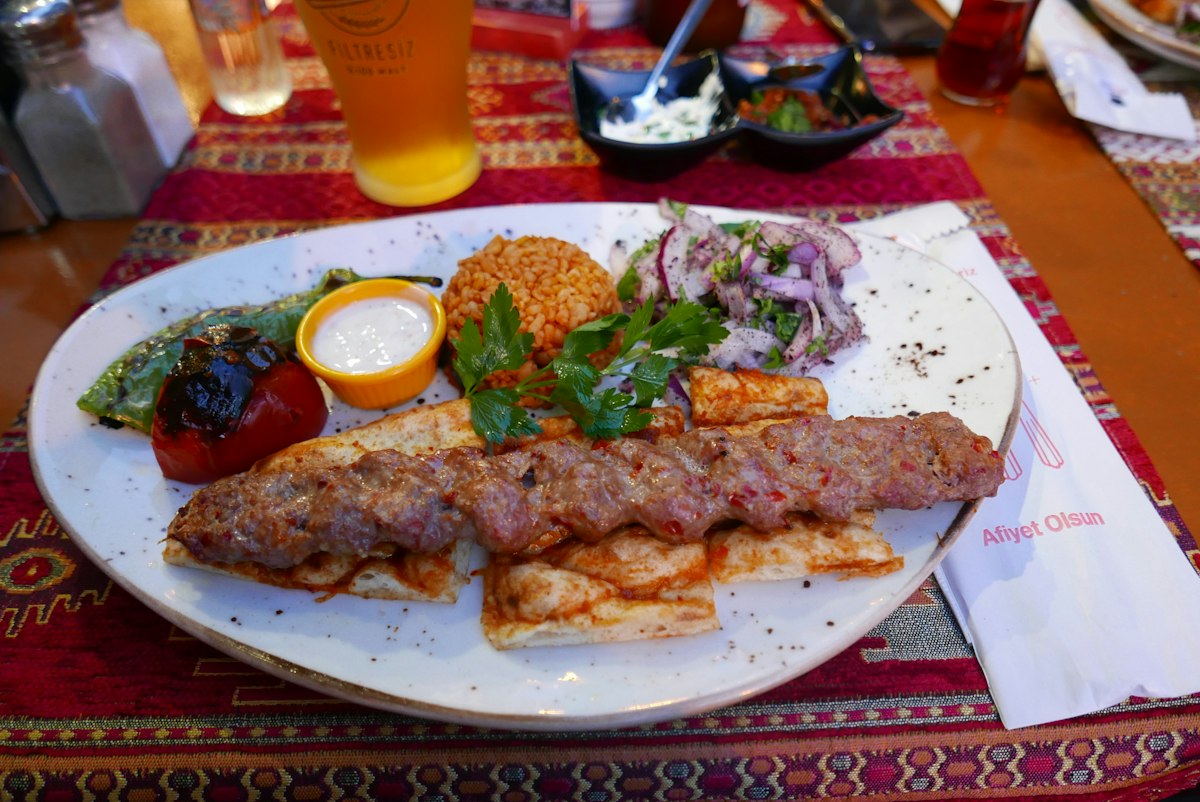
If you eat one dish in Marrakech, make it tanjia. Beef or lamb goes into a tall, narrow-necked clay pot with preserved lemon and spices, the mouth is sealed with paper, and the pot goes to the attendant who tends the furnace of the neighborhood hammam, the public bath. After hours in the embers, the meat comes apart at the touch of a spoon. At night on Jemaa el-Fna, it's the harira, made with lentils and beans, and the snails in spiced broth ladled out from carts that stay with you. Meals end with mint tea: green tea steeped with fresh mint and plenty of sugar, poured from a pot held high so it foams. During Ramadan, many local restaurants stay closed until sunset. Then, the moment the sun goes down, the meal that breaks the fast begins all at once across the streets.
Riads and hammams
If you're staying in the medina, choose a riad. From the lane there's just a plain door, but inside, rooms wrap around a courtyard with a fountain or a small garden. Thick earthen walls leave only birdsong and running water in the courtyard. Breakfast is usually served on the roof terrace, and sitting there over layered, pan-fried msemen and honey, looking out toward the Atlas, is the quietest part of the day. The hammam is Morocco's steam bath. You rub on black soap made from olives (savon beldi), warm up in the steam, then scrub off dead skin with a rough glove (kessa). Public hammams split men and women by hours or entrances; for a first visit, you can leave it to an attendant at a riad or spa hammam.
A day beyond the walls, and a sample plan
After a few days in the medina, spend one outside the walls. Berber villages in the foothills of the Atlas, the Agafay, a desert of stone and earth, and Essaouira, a windy port town on the Atlantic, are popular day trips from Marrakech. Day 1 — Check in to your riad → Jemaa el-Fna at dusk → dinner at the stalls Day 2 — Souks → Koutoubia Mosque → Palais El Badi and the Saadian Tombs → hammam Day 3 — Jardin Majorelle → Musée Yves Saint Laurent → rooftop café → tanjia for dinner Day 4 — Day trip to the Atlas foothills or the Agafay desert → a last night in the square
- Best season
- Mar–May (spring), Sep–Nov (autumn)
- Recommended length
- 3–4 days
What to eat
- Tanjia (Marrakech's clay-pot meat)
- Tagine (cooked under a cone lid)
- Harira (lentil and bean soup)
- Mint tea (sweet green tea)
Handy tips
- Tickets for Jardin Majorelle and the Musée Yves Saint Laurent are sold only online, on the official site (tickets.jardinmajorelle.com). Tickets bought on other sites won't get you in, and the museum is closed on Wednesdays.
- Taking dirhams out of Morocco is tightly controlled, so change leftover cash back at the airport when you leave. The airport requires an exchange certificate for this, so keep the one you're given each time you change money.
- In a petit taxi, ask for the meter or agree on the fare before you set off. Fares carry a 50% surcharge from 8pm to 6am.
Book
We are not party to bookings. Provider terms govern bookings/payments/refunds. We earn commission on our link bookings.