Germany
Frankfurt
Coronation lanes behind the towers
Apple wine across the Main at dusk
It's easy to remember Frankfurt as the airport where you changed planes. But head into town, walk a little way out from the glass towers, and you're on the route kings and emperors walked to be crowned. The lanes between the cathedral and the town hall were rebuilt in 2018, and the house where Goethe was born was restored to its original structure after the war. On the south bank, old villas now hold museums, and after dark you might end up sharing a table with strangers in an apple wine tavern. Frankfurt has rebuilt what it lost, so new buildings and rebuilt ones stand side by side on the same block.
Along the coronation route
Frankfurt Cathedral was never a bishop's seat, yet it's known as the Kaiserdom, the emperors' cathedral. German kings were elected here from 1356, and Holy Roman emperors were crowned here from 1562. Climb the tower's 328 steep steps and the whole city spreads out below you. Between the cathedral and the Römer, which has served as the town hall since 1405, runs the route kings and emperors walked to their coronation. The New Old Town (Neue Altstadt) along it was finished in 2018: of its 35 houses, 15 are faithful reconstructions and 20 are new. Down one lane is a museum for Heinrich Hoffmann, the doctor who wrote Struwwelpeter (Shock-Haired Peter) in 1844. The town hall tower, Langer Franz, was finished in 1904 at 70 m. Air raids in March 1944 destroyed its top, and in the 1950s rebuild, cost concerns meant it got only a makeshift roof, leaving it at 45 m. Work to restore the historic top is underway, with completion planned for 2027.
Goethe's house and St Paul's Church
The Goethe House is where Goethe was born, at noon on 28 August 1749, and where he grew up. It's also where he wrote Götz von Berlichingen and The Sorrows of Young Werther. The house was completely destroyed in World War II and rebuilt to its original structure by 1951. From the room with the puppet theatre to the library and kitchen, it's furnished in 18th-century style. On Thursdays it stays open until 9 pm. St Paul's Church (Paulskirche) is where the first all-German parliament met, on 18 May 1848. The Peace Prize of the German Book Trade is presented here too (on 11 October in 2026).
Museums on the south bank
The Schaumainkai, on the Main's south bank, was lined with old villas set in large gardens. In 1978, Deputy Mayor Hilmar Hoffmann came up with the idea of tying the area together as a cultural quarter, and in 1984 two of the villas became the German Architecture Museum and the German Film Museum. That's how the Museum Embankment (Museumsufer) began. At its heart is the Städel Museum, founded in 1815 as a civic foundation by banker and merchant Johann Friedrich Städel. It's regarded as Germany's oldest museum foundation. More than 700 years of art run through it, from Cranach and Dürer to Botticelli, Rembrandt and Vermeer. On Tuesdays from 3 to 6 pm, entry is €10. On the last Saturday of every month, many museums are free (in August, municipal museums use the Saturday before).
The Bembel and the diamond-patterned glass
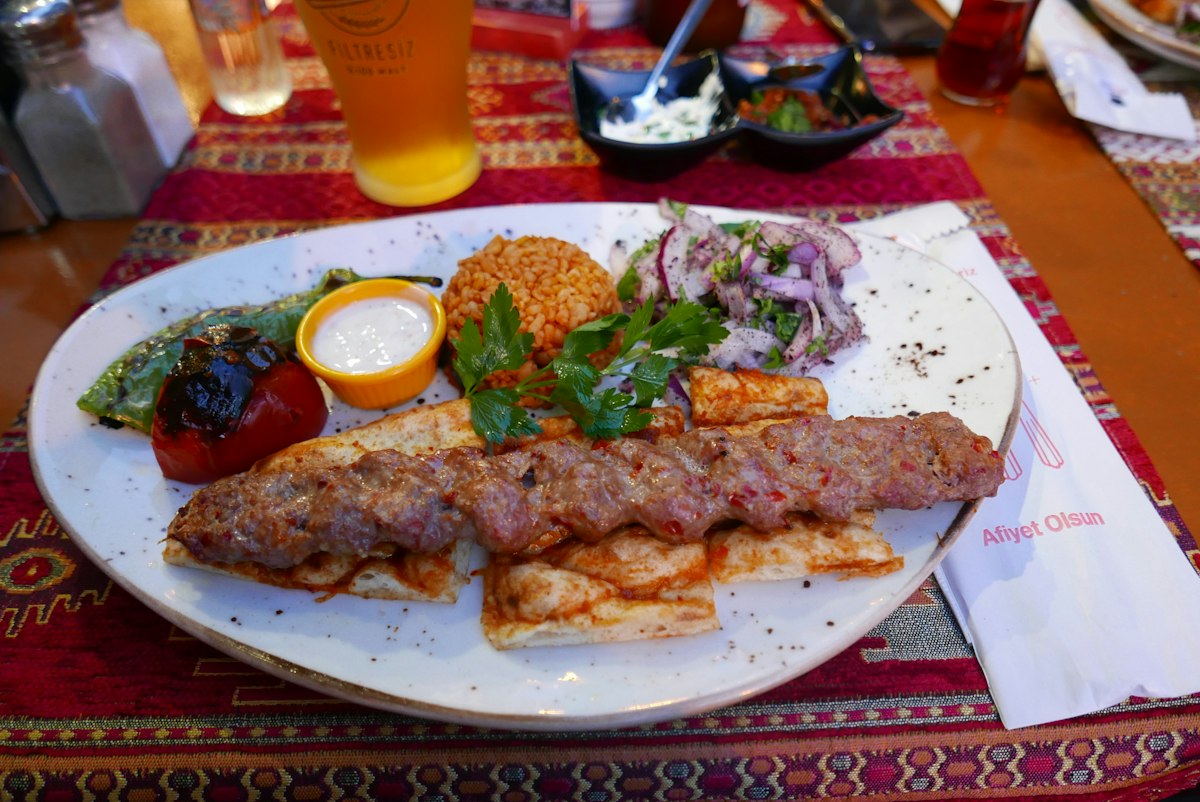
Apple wine (Apfelwein), also called Ebbelwoi, arrives in a Bembel, a Hessian stoneware jug. You order a 1-litre or 5-litre Bembel; in the past, a Bembel was a unit of measure holding exactly eight Schoppen. It's poured into a Gerippte, a glass with a diamond pattern that comes in 0.25, 0.3 and 0.5 litre sizes. If the strength puts you off, order a Gespritzter, cut with water. Plenty of these taverns are across the river in Sachsenhausen. Order Handkäs mit Musik on the side: small, round sour-milk cheeses marinated in olive oil, onions and caraway. The 'music' in the name refers to the raw onions.
Tasting Frankfurt at the market
The Kleinmarkthalle is an indoor market that opened in 1954, with more than 60 stalls. It closes at 6 pm on weekdays and 4 pm on Saturdays, and it's shut on Sundays. Try Frankfurter Würstchen here: a 1929 resolution protects their origin, so only those made in and around Frankfurt count as the real thing. Grüne Soße is a cold sauce made from seven herbs: chives, parsley, chervil, borage, sorrel, burnet and cress. It's eaten with boiled eggs and jacket potatoes. For dessert, there's Frankfurter Kranz, a cake dating back to 1735, and Bethmännchen, marzipan biscuits. Today they carry three almond halves, but there used to be four, one for each son of the Bethmann banking family.
Nights on the Main
The Main Tower has 56 floors, and its rooftop deck sits about 200 m above the street. Adult entry is €9. In summer it stays open until 11 pm on Fridays and Saturdays, which leaves plenty of time to watch the towers light up after sunset. The last lift goes up 45 minutes before closing. During the Christmas market, more than 230 stalls go up across six spots, including Römerberg, the Mainkai and Paulsplatz (23 November to 22 December in 2026). With a mug of hot apple wine in hand, pick out some Quetschemännchen, made from dried plums and nuts held together with wire, as a souvenir.
Suggested itinerary: 3 days, 2 nights
Day 1 — Arrive at the airport → Römerberg and the cathedral tower → New Old Town lanes → Main Tower at night Day 2 — Goethe House → St Paul's Church → lunch at the Kleinmarkthalle → across the Eiserner Steg to the Städel → dinner at an apple wine tavern in Sachsenhausen Day 3 — Museum Embankment walk (architecture and film museums) → shopping on the Zeil → airport
- Best season
- May–Sep (long days, river walks), late Nov–Dec (Christmas market)
- Recommended length
- 2–3 days
What to eat
- Apple wine, or Ebbelwoi (Sachsenhausen taverns)
- Grüne Soße (seven-herb green sauce)
- Handkäs mit Musik (cheese marinated with onions)
- Frankfurter Würstchen (at the Kleinmarkthalle)
Handy tips
- The airport S-Bahn station (S8, S9) is beneath Terminal 1. A city day ticket (€7.75) doesn't cover the airport, so between the airport and town use a single (€6.90) or a 1-day Frankfurt Card (€13), which does.
- The MuseumsuferTicket costs €21 and gets you into 39 museums on two consecutive days. The Städel alone is €19, so it pays off if you plan to see two or more.
- The Ebbelwei-Express, an apple wine sightseeing tram, runs on Saturdays, Sundays and public holidays, except Good Friday, Corpus Christi and two memorial Sundays in November (Volkstrauertag and Totensonntag). The roughly one-hour loop costs €8, cash only, including a bottle of apple wine, apple juice or water and a bag of pretzels.
Book
We are not party to bookings. Provider terms govern bookings/payments/refunds. We earn commission on our link bookings.