Softly, simply
Long after the snowy views of Hida had blurred, the smells were still with me. So I've written this one nose first, putting what lingered ahead of what I saw.
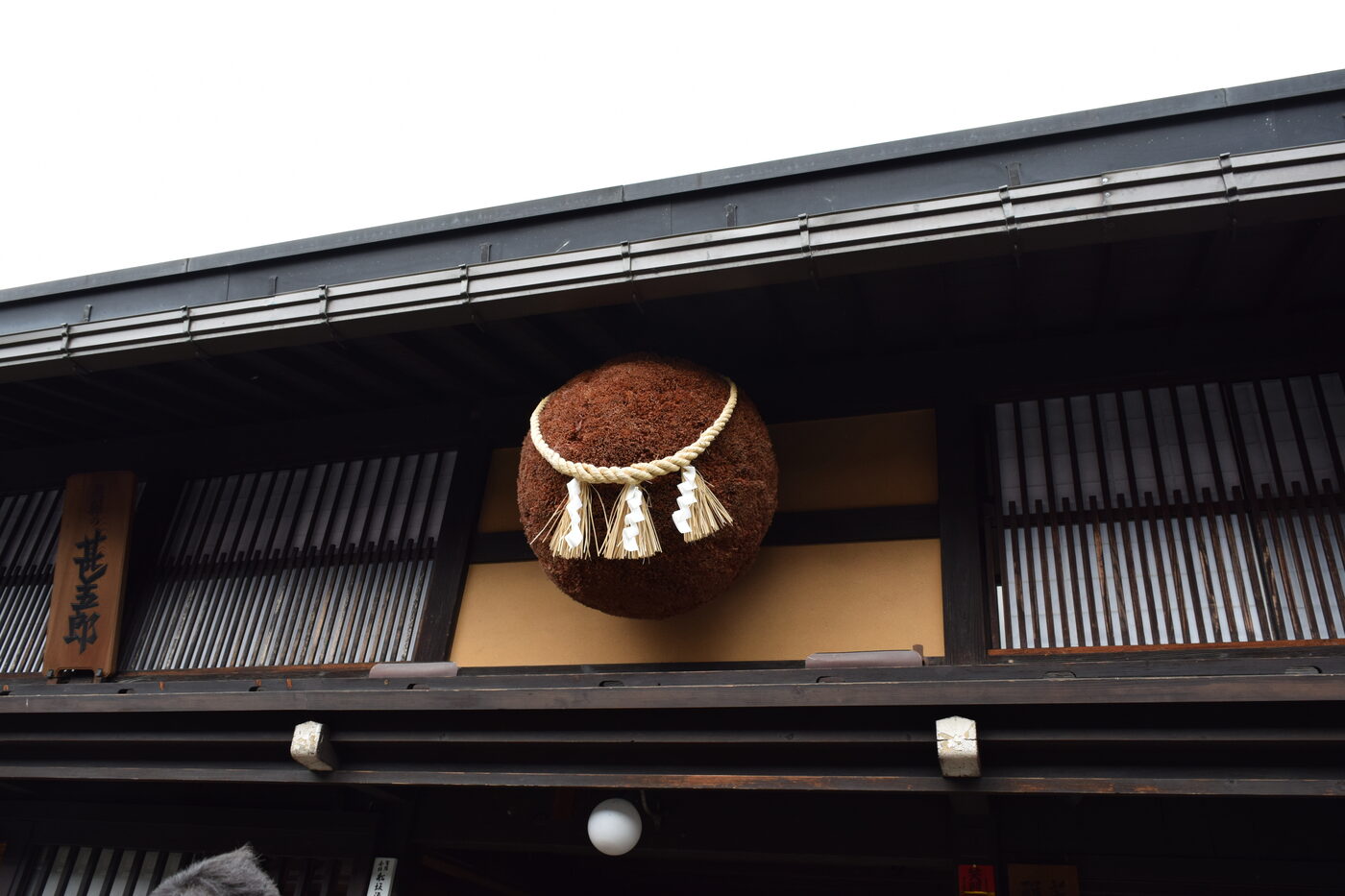
On a lane in Sanmachi, Takayama's old town, under a thin layer of snow, the first thing to stop me was a round ball of cedar leaves hanging from the end of an eave. From beneath that eave drifted a sweet smell, like rice steaming. Here they call the ball a sakabayashi (酒ばやし), the sign a sake brewery hangs at its door. On one loop of the old streets, I looked up at the same kind of ball again and again.
This is four nights and five days: up into the mountains from Nagoya for two nights in Takayama and one in Shirakawa-go, a village of gassho-zukuri (合掌造り) houses, then back out to Nagoya for one more. Sake in the air outside the breweries, miso toasting on the breakfast tray, wood smoke from the irori (囲炉裏) hearth of a gassho house. Like a perfume moving from its first note to its last trace, the first three days went looking for where each of those smells came from, and the last two carried what was left back to the city.
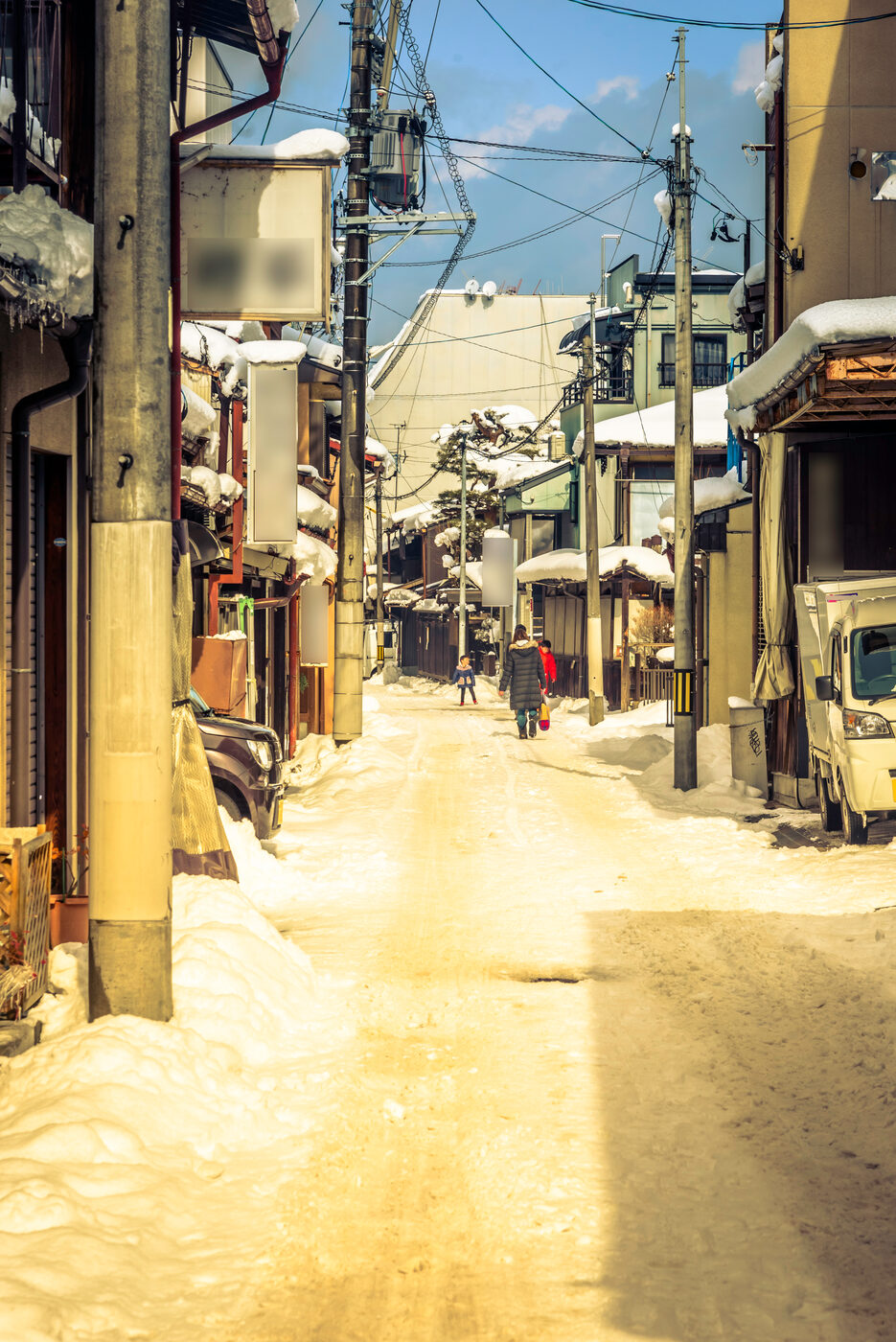
Day 1 — Where the sake reaches you first
I landed at Centrair (Chubu Centrair International Airport), took the Meitetsu μ-SKY into Nagoya Station, and changed there to the JR Limited Express Hida (ひだ). From a window seat I watched the city give way to mountains, and dozed off. When I opened my eyes, there was snow on every roof outside.
My first seat in Sanmachi was at Tofu Ryori Guchiya (とうふ料理のぐちや). The restaurant belongs to a tofu maker of more than 100 years, so the menu ran through komo tofu, giseiyaki and yudofu. I'd never had komo tofu (こもどうふ) before. It's tofu rolled in a straw mat and simmered, so when I pressed it with my chopsticks, broth seeped from every tiny hole. This is the tofu people here set out for festivals and New Year, and I was having it for lunch on a snowy Saturday. There was hardly any seasoning to be seen on the plate, and still my chopsticks didn't stop.
Once I was full, I went back to following that sweet smell. Up and down three parallel streets, where latticed houses stand eave to eave and clear water runs beneath the eaves, I came to a stop outside Funasaka Sake Brewery (舩坂酒造店) on Kami-Sannomachi. A tasting corner sat to one side of the shop. One sip of Miyamagiku (深山菊), the brewery's own sake, and the sweetness that had followed me down every lane turned into the taste of sake in my mouth.
My ryokan, Honjin Hiranoya Kachoan (本陣平野屋 花兆庵), was a walk from there. It has a hot-spring bath built inside a white-walled earthen storehouse (for women) and an open-air bath at the top of the annex (for men), so I warmed up before dinner. At the center of the dinner tray was Hida beef fillet on an iron griddle. When the fat started to sizzle on the plate, the sake that had hung under my nose all day finally gave way to the smell of the meat.
Day 2 — Miso toasting on a leaf
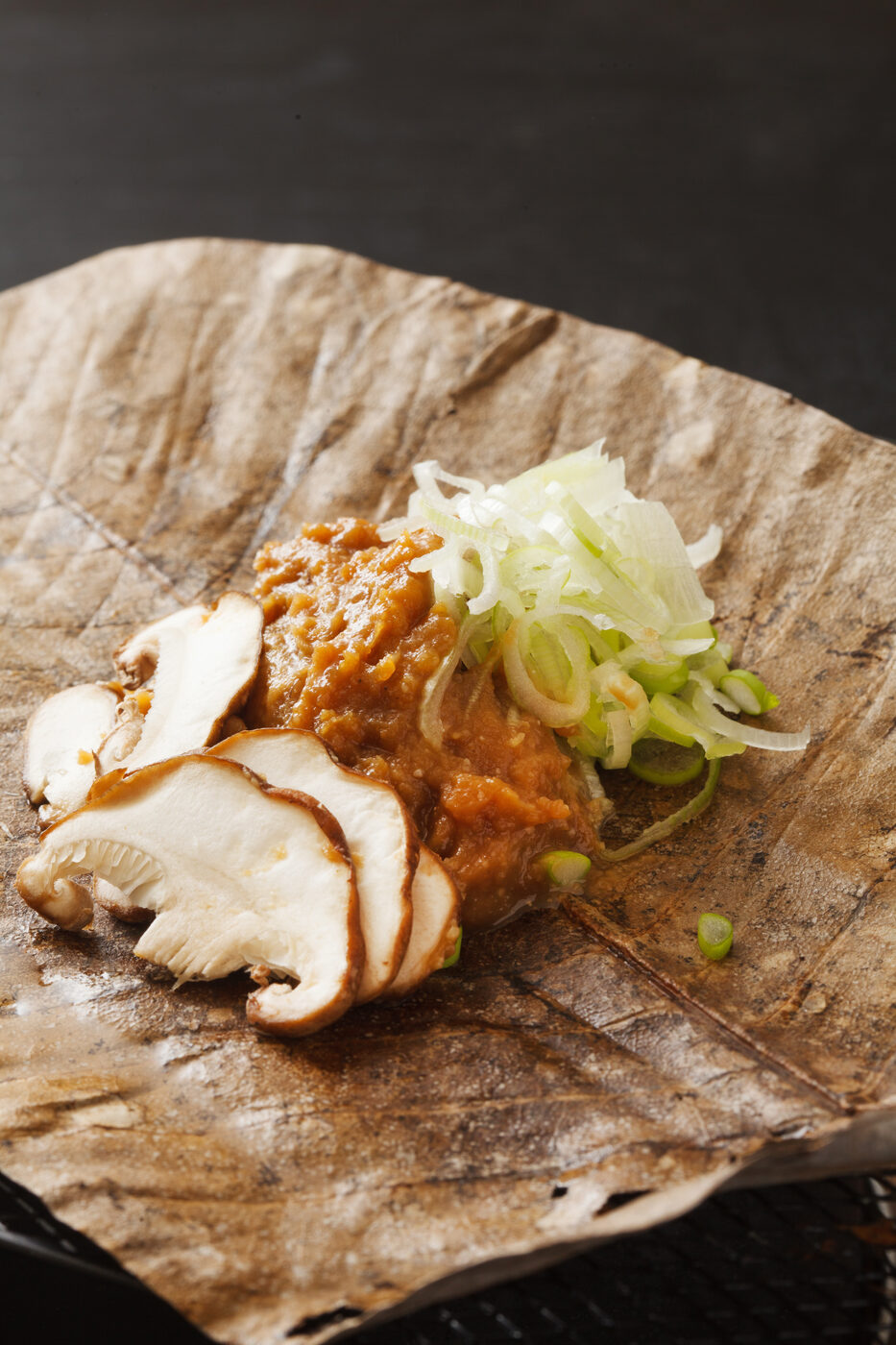
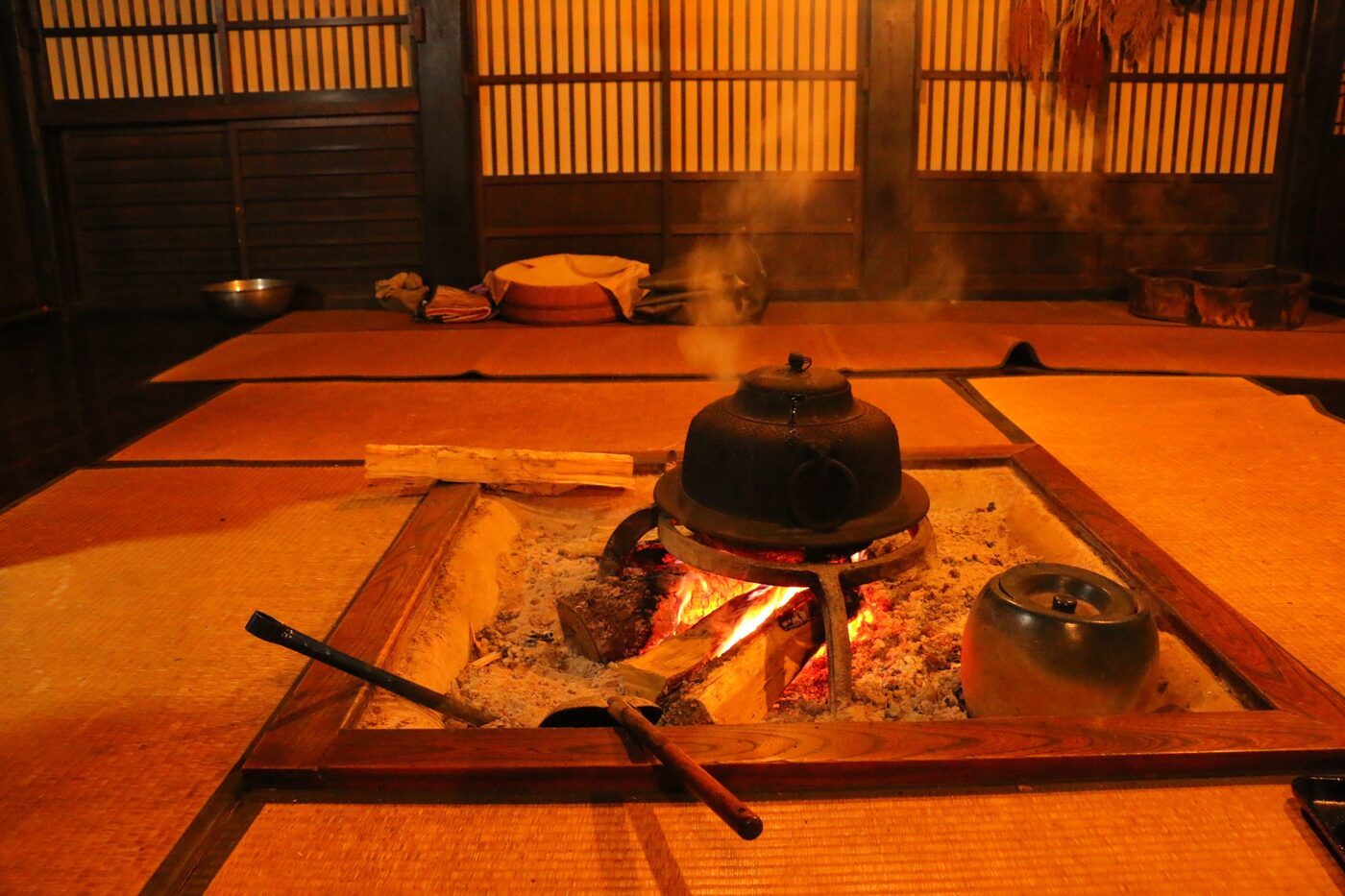
On a small stove sat a single dried leaf. It was a magnolia leaf (朴葉) that had fallen in autumn, with miso spread on top. This breakfast dish, hoba miso (朴葉みそ), comes from the way people in Hida warmed pickles and miso over the irori fire in the cold of winter. As the edges of the leaf curled and began to toast, the room filled with a warm, nutty smell. That was the smell of day two.
Still in clothes that smelled of miso, I went out to the Miyagawa Morning Market (宮川朝市). Stalls lined the east bank of the river, and since it was winter, they were filled with foods made to keep: miso, pickles, mochi. Takayama's morning markets go back to the kuwaichi (桑市), held around Takayama Betsuin (高山別院) from about 1820, and the market moved to this spot by the river in 1962. For a while, the miso from breakfast and the miso on the stalls followed me together.
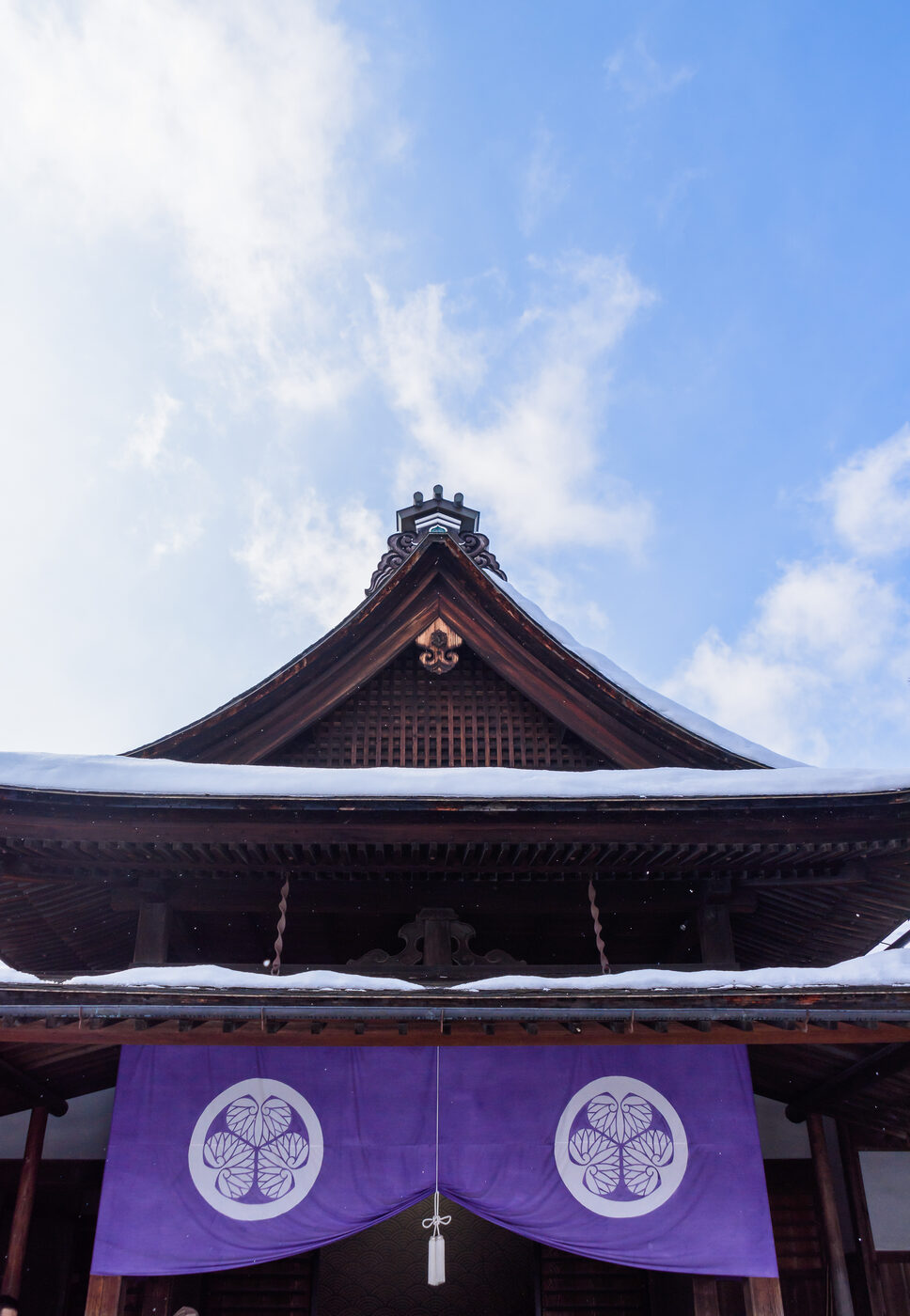
From the end of the market, a short way down along the river, I came to the gate of Takayama Jinya (高山陣屋). For 176 years from 1692 it was the office from which the shogunate governed Hida, and of the 60 or so such offices at the end of the shogunate, it's the only one whose main buildings survive. I lingered a long time in front of the storehouse (御蔵) where the rice paid as tax was stacked. Thinking of it as the place where this region's rice piled up as tax, I saw the mochi and miso on the stalls I'd just passed a little differently.
At the Kusakabe Folk Museum (日下部民藝館), I sat for a long time beneath the dim space that rises all the way to the roof. The house was rebuilt in 1879 on the site of a merchant home that had burned, exactly in the Edo-period style, and that height stayed with me long after. Lunch was at Teuchi Soba Ebisu Honten (手打ち蕎麦 恵比寿本店) on Kami-Ninomachi. In a room that still has the feel of a Meiji-era shop house, I dipped soba, made by hand every day, they say, into a tsuyu they say is aged a long time. Only after I'd put down my chopsticks did I learn it's the oldest soba shop in Takayama.
I rested my tired legs at Aika Coffee (藍花珈琲店), in the middle of Sanmachi. Sitting among antique furniture in a shop built as a kura (蔵) storehouse, I caught the smell of charcoal-roasted beans slowly rising. After dark, I followed the smell of broth to Kikyoya (桔梗屋) in Honmachi. The bowl came with a clear soy-sauce broth and thin, wavy noodles. Takayama ramen, made by simmering the broth and the seasoning together in one pot, began in 1938 with a single street stall. After a morning of miso, that clear broth tasted especially light.
Day 3 — Under roofs steeped in irori smoke
I caught the Nohi Bus (濃飛バス) to Shirakawa-go at the Takayama Nohi Bus Center. From December 1, buses in this direction run as reserved services, with bookings opening a month ahead. When I stepped off, a faint trace of smoke hung in the cold air.
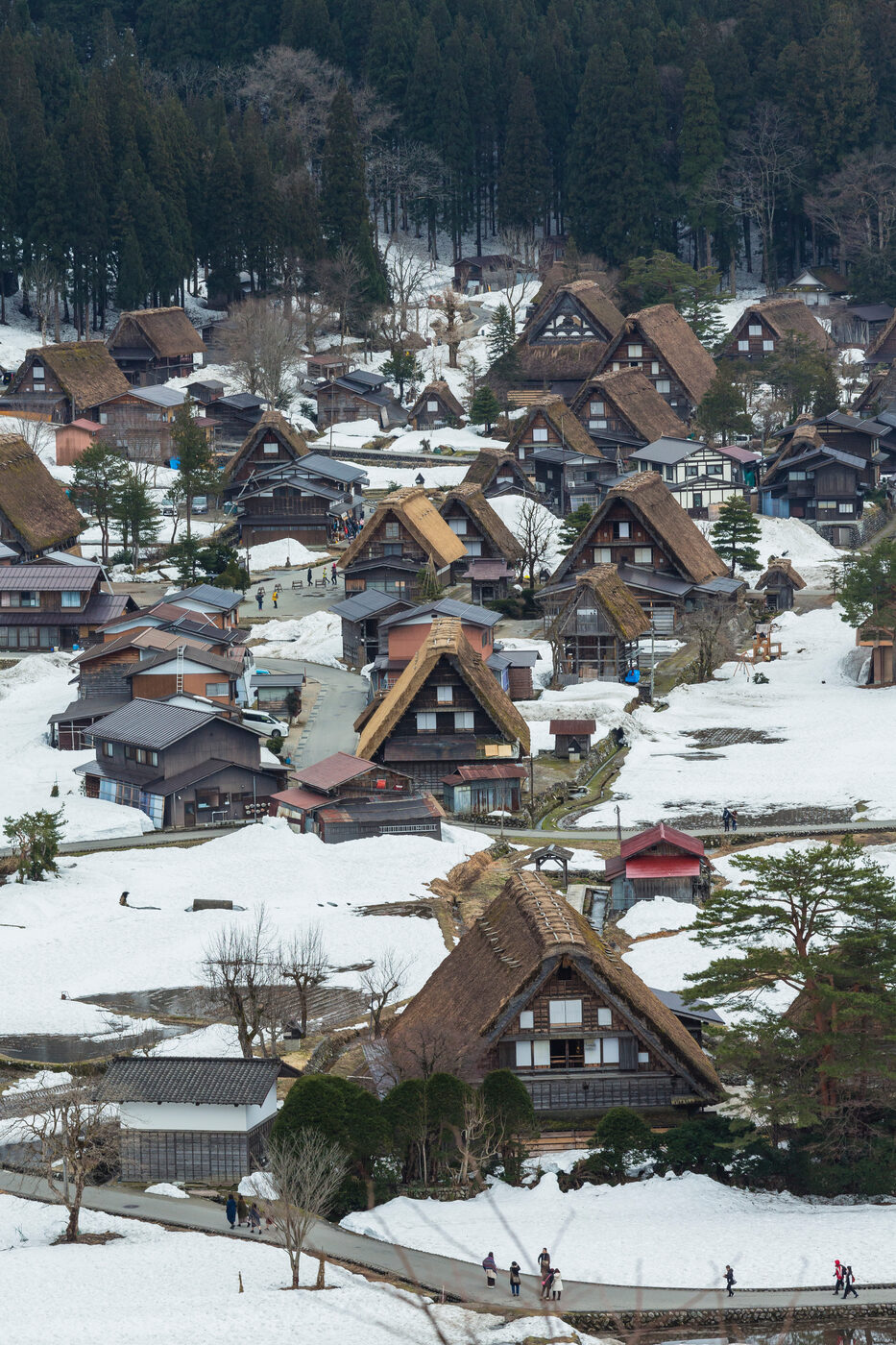
Gassho-zukuri takes its name from the steep triangle of the roof, said to look like two hands pressed together in prayer. That pitch keeps the valley's heavy snow from piling up on top. The Wada House (和田家) is the largest of the hundred or so gassho houses in the village. Stand in front of it and there are two doors. The small one on the right was for the family; the large one on the left was for honored guests, such as officials. That one big door was enough to suggest that a family which grew rich making and selling saltpeter, and raising silkworms from the late 1800s, led the village throughout the Edo period. On the second floor, snow-covered roofs ran on beyond the windows.
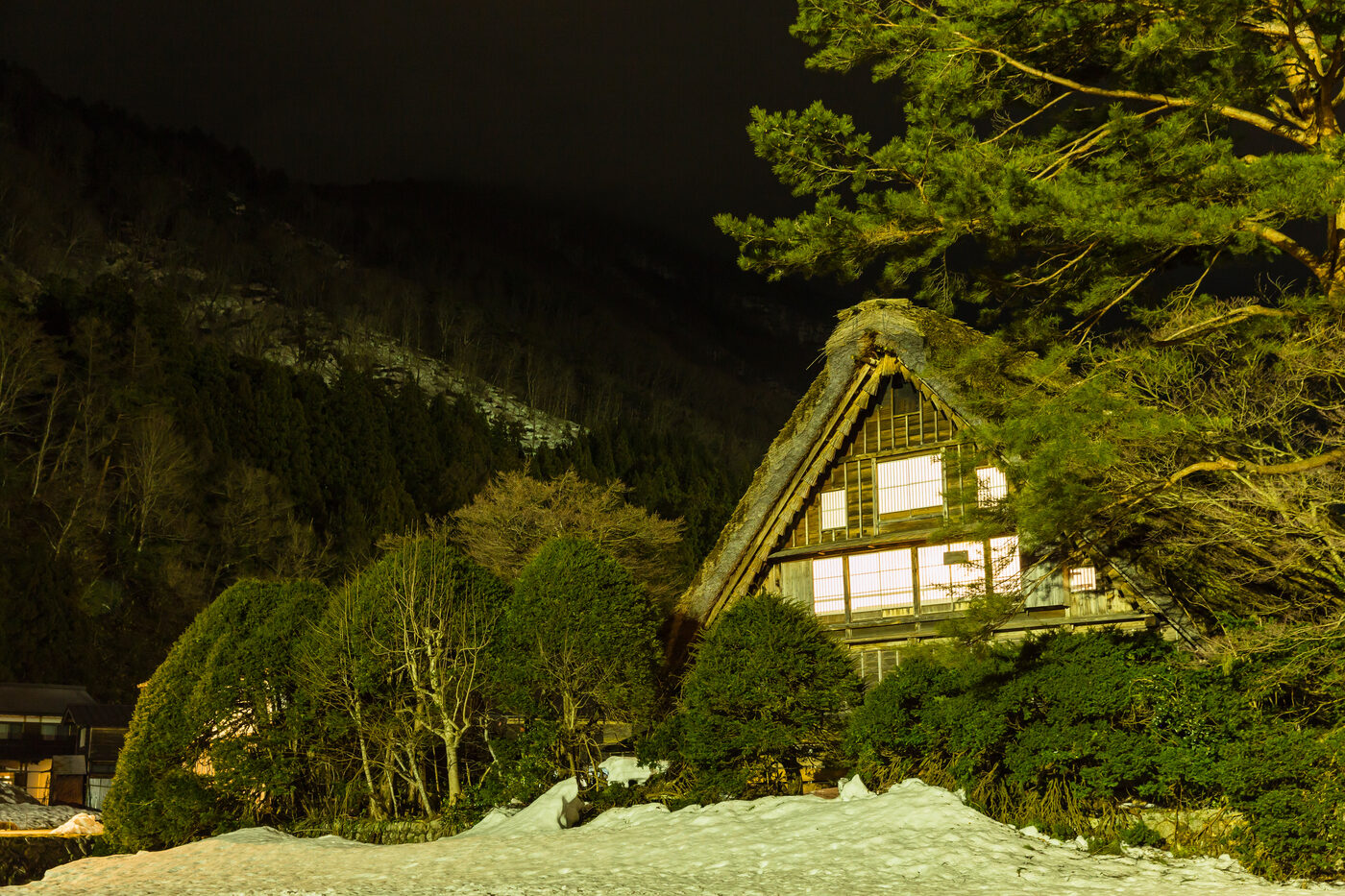
The smell I'd noticed off the bus grew stronger as soon as I walked into Kissa Ochiudo (喫茶 落人). A pot hung over the irori on the ground floor of the gassho house, and I ladled myself two helpings of zenzai (ぜんざい), sweet red-bean soup cooked not too sweet. I went back for more of the five-grain-rice curry, too. For coffee, I chose one of the cups hanging on the wall and had it brewed with spring water. Late in the afternoon, I thawed out in the natural hot spring at Shirakawa-go no Yu (白川郷の湯), next to the bus terminal.
That night I stayed at Minshuku Bunroku (民宿 文六), a gassho guesthouse with its back to the mountain. Its listing said dinner is made from rice and vegetables grown at home and wild greens gathered in the hills. Once the sun went down and the day visitors had left, all that remained in the village were a few lit windows and the sound of feet on snow. It's said to be a house where you wake to birdsong and running water; in winter, the water came first.
Day 4 — A temple that keeps its fire, then back to the city
At 9 a.m., I walked into the Myozenji Folk Museum (明善寺郷土館) the moment it opened. A temple whose main hall, priests' quarters (庫裏) and bell tower all survive in gassho-zukuri style is said to be hard to find anywhere else. The irori here is lit every day. On that winter morning, smoke from the first fire spread slowly toward the ceiling of the priests' quarters. The village smell that had soaked into my clothes over the day was at its strongest here.
Walking from Myozenji toward Deai-bashi (出会い橋), I stopped short of the bridge at Shokuji Kissa Konjaku (食事喫茶 今昔), a tea room in a gassho house. It's mainly a soba place, but I ordered shirudango (汁だんご), dumplings floating in broth. Only once the warm broth had loosened me up did it sink in that it was time to leave the mountains. On Deai-bashi I looked back once toward the village, then boarded the Nagoya–Shirakawa-go Line highway bus.
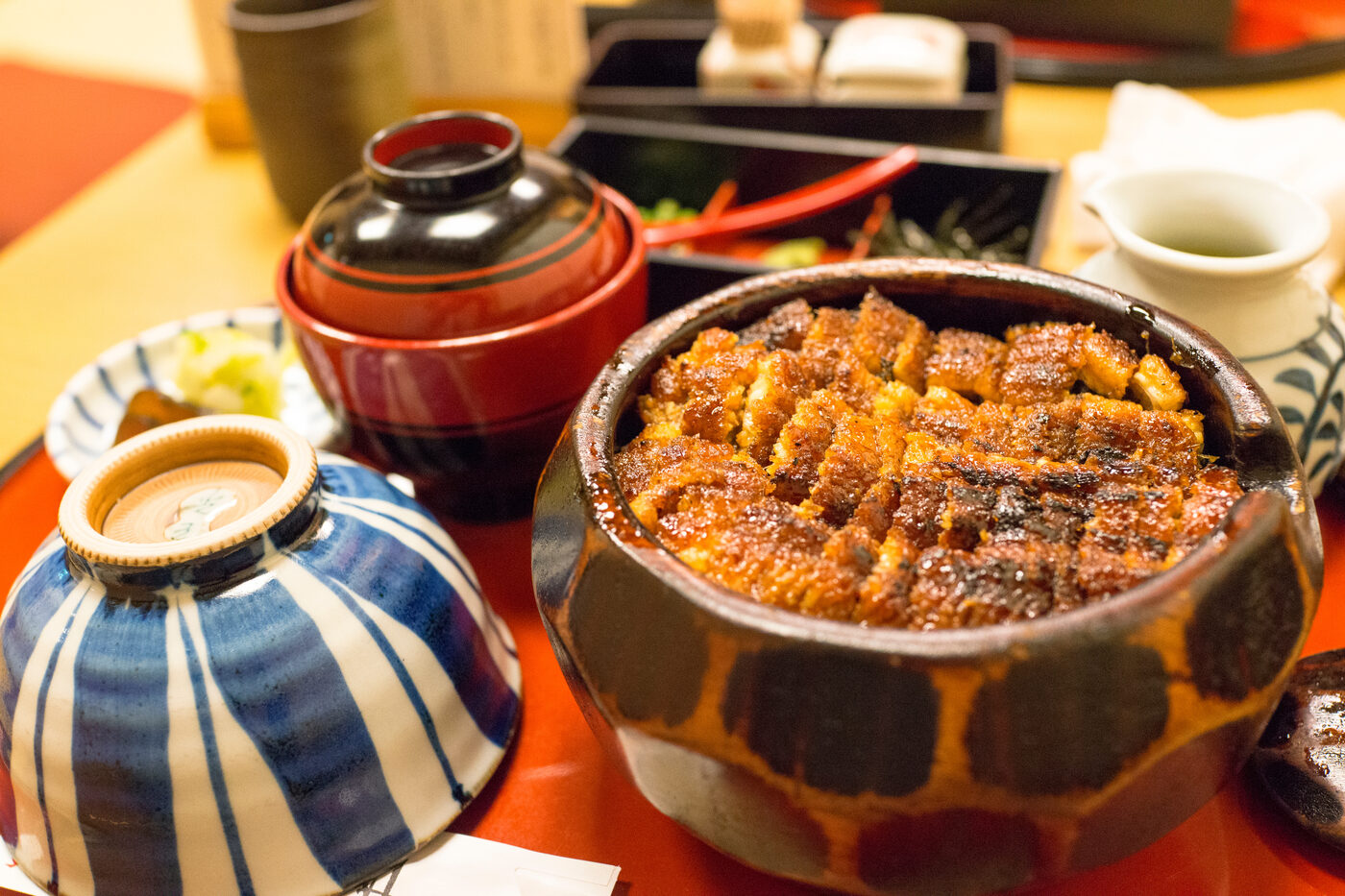
When I stepped off at the Meitetsu Bus Center, the sounds of a city, my first in three days, rushed in all at once. Dinner was hitsumabushi at Atsuta Horaiken Honten (あつた蓬莱軒 本店). The dish, they say, came out of broken bowls. Delivery staff kept breaking the empty bowls as they carried them back, so Jinzaburo, the second-generation owner, and Ume of the restaurant came up with a wooden bowl that wouldn't break easily. When several people's portions went into one big bowl, the eel disappeared first and the rice was left over, so the restaurant began chopping the eel and mixing it through the rice (まぶす) before serving. I ate the first bowlful just as it came, and added the yakumi (薬味) served alongside to the second. When I poured tea over the third, the steam briefly pushed back the smoke I'd brought down from the mountains.
Day 5 — Rich miso, a lingering trace
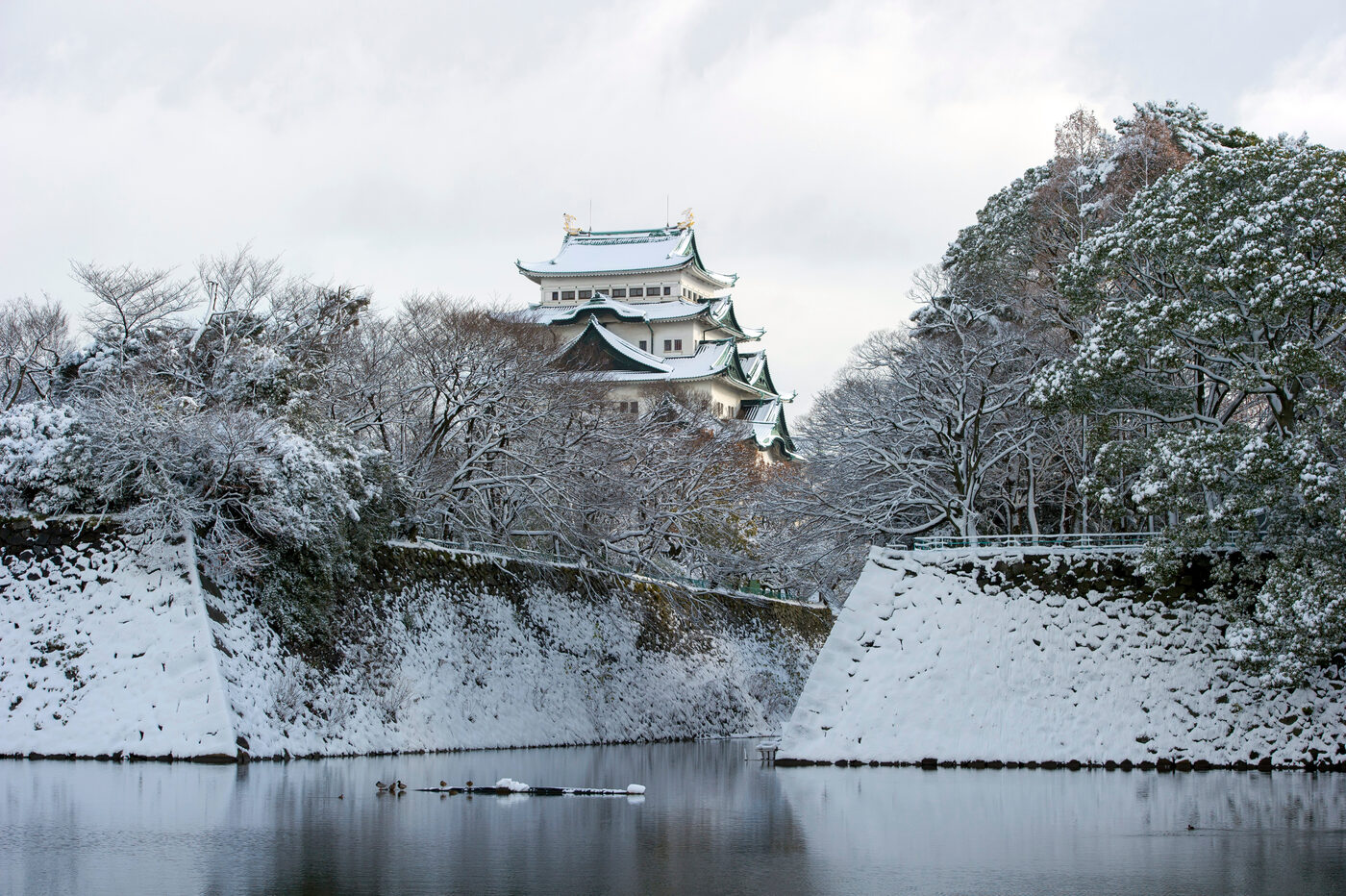
I spent my last morning at the Honmaru Palace (本丸御殿) of Nagoya Castle. Inside the palace, whose restoration was completed in 2018, I walked slowly past the paintings on its sliding screens, cedar doors and ceilings. After three days in mountain villages, the gold paintings looked almost unfamiliarly lavish. In this city, my eyes got busy before my nose did.
Over miso nikomi udon at Yamamotoya Sohonke Kinshachi Yokocho (山本屋総本家 金シャチ横丁店), in front of the castle's main gate, I thought back to the hoba miso at breakfast on day two. The miso that had toasted on a leaf was broth in a pot here. To my tongue it was far richer. Before the train to the airport, I had miso katsu, a cutlet topped with miso sauce, at Yabaton Nagoya Station Esca (矢場とん 名古屋駅エスカ店), underground at the station. Only after miso twice in one day, the rich kind both times, did I feel I was beginning to know the smell of this city.
- Day 1 — μ-SKY (airport → Nagoya, 28–35 min) → Limited Express Hida (about 2 hr 20 min) → Tofu Ryori Guchiya → Funasaka Sake Brewery → Kachoan (night 1)
- Day 2 — Hoba miso breakfast → Miyagawa Morning Market → Takayama Jinya → Kusakabe Folk Museum → Ebisu Honten → Aika Coffee → Kikyoya → Kachoan (night 2)
- Day 3 — Nohi Bus (about 50 min · book from a month ahead) → Wada House → Kissa Ochiudo → Shirakawa-go no Yu → Minshuku Bunroku (night 3)
- Day 4 — Myozenji Folk Museum → Konjaku → Deai-bashi → Highway bus to Nagoya (all seats reserved · from a month ahead · ¥3,600–4,700) → Horaiken Honten → A stay in Nagoya (night 4)
- Day 5 — Nagoya Castle Honmaru Palace → Yamamotoya Sohonke → Yabaton Esca → μ-SKY
Leaning against the μ-SKY window, I could still smell smoke on my collar. The sake from the first day's lanes had long since faded, but the irori smoke and the miso followed me all the way to the airport. A good perfume works the same way: the first notes fly off early, and what lies beneath stays the longest. Once you've set your dates, book the bus from Takayama to Shirakawa-go and the highway bus to Nagoya first, a month ahead.
Book
We are not party to bookings. Provider terms govern bookings/payments/refunds. We earn commission on our link bookings.